Viser opslag med etiketten books/films. Vis alle opslag

søndag, april 06, 2008

Films to hone your maternal instinct

Good news (for me, probably not much of any kind of news to anyone else): My childbirth preparation class does not seem to include any videos of actual births.

Bad news following from the good news: After seeing so many films where people watch videos of births to prepare for birth, I feel that I'm missing out.

So, to help myself prepare cinematically, I am in the process of making a list of films which focus on birth and newborns. Here is what I have so far. Feel free to add more in the comments. And yes, I realize that these films don't give a totally rosy perfect picture of how these things are, but it's important to prepare for all eventualities.

1) All films in the Alien series. Because, as I believe I've mentioned before, you never know when a cesarian might be indicated. An added bonus is the strong women in the series, who are good role models for motherhood.

2) Rosemary's Baby. This can teach women to trust their instincts at all stages of pregnancy. And it proves that mothers love their children, no matter how horrific they actually are.

3) The Omen. This is a lesson in keeping your child in sight at all times from immediately after the birth.

4) Humanoids from the Deep. This is one actually that I haven't seen, but was told about. I'm not sure what the moral of this one would be. Maybe that in whatever you think you're suffering, the women in this film have it worse?

O.K., it's up to you now. What films would you suggest, which focus on pregnancy and/or babies. You can see the types of films I'm getting at, but feel free to add others with other feels to them.

lørdag, januar 05, 2008

More chocolate?

I believe I'm beginning to sense a pattern. The book, A Natural History of the Senses, by Diane Ackerman. The passage, chosen totally at random, from a passage entitled 'The psychopharmacology of chocolate'. It starts, 'what food do you crave? Ask the question with enough smoldering emphasis on the last word, and the answer is bound to be chocolate.' Following is a several pages on the history and chemistry behind that marvelous substance.

Is this, however, the food that you crave? I certainly like chocolate, but truth be told, the following section in the book 'In praise of vanilla' is perhaps more to my particular taste. Garlic and especially ginger also feature heavily in my cravings. And comfort food, peanut butter (if I ever really need proof of where I was raised, that's probably it), pasta with elaborate sauces, or just with butter, or just with parmesan. Cheese on toast. For my sweet tooth, ice cream. Whenever possible, new foods that I cannot even imagine before they present themselves to me, or I stumble upon them. However, all that said, I do have the occasional craving for chocolate (dark or white, not so much all the stuff in between).

And what about you? When you find that only a certain food will suffice, what food is it that inspires such passion? Do you agree with Diane Ackerman's assumption that we are all chocolaholics?

søndag, november 11, 2007

Follow the yellow brick road?

A few California trips ago, I was in the market for plane reading, and was gifted with a copy of Wicked. I still haven't read it, though I certainly intend to. Thor read it, and really enjoyed it. But what shocked me was when I asked him how it compared to the original book or the film...and he had no idea what I was talking about. Clearly, the Wizard of Oz hasn't had such an impact on young Danes as on, well, pretty much all Americans. Not being able to find a library copy of the L. Frank Baum book, I found a copy of the 1939 film for us to watch instead. I don't recall Thor being overly impressed, though he didn't dislike it, and he could see the cultural importance of it (in the sense of references to it that he had seen before and not then recognized). I was left with the thought that much of why I like the movie is simply because it's been such a part of my childhood and life. So, it's a classic, but for purely cultural reasons.

Today the Imperial (a single-big-screen cinema in central Copenhagen) ran a one-off Sunday matinee showing of The Wizard of Oz. So, of course we could not miss it. All the elements were there, the songs, the plot twists, the big lines ('I'll get you my pretty...and your little dog, too!'), all things that I grew up with. Now, after seeing the film with Thor, I found myself examining the specifics, and the film as a whole, with the question of how a film that is so dated can still be so interesting.

Because certainly not everything works today. The role of Glinda especially is in my mind far too painfully innocent and sweet, with very implausible appearances when all seems darkest for our heroine (her final appearance teaching Dorothy how to use the ruby slippers seems particularly Glinda ex machina). The munchkins seem like a parody of themselves. And of course, while the sets and effects (and of course the technicolor) were modern for their day, it all seems a bit low-budget now. The moral of the story, that anything of real value will be found no further than in your backyard, is limiting. Perhaps it is true that 'there's no place like home', but I still maintain that you can only realize this by leaving home to begin with. And that home is not necessarily the place you're originally from (or only one place at all).

This does not mean that the movie as a whole doesn't work, because it still does. The sets and effects are still effective, though through a wave of nostalgia. The better-known songs are better-known for a reason, which is that they're catchy. The colors are so old, they're retro. Actually, I would love to have been in an audience not used to everything in color for that scene where Dorothy opens the door of the farmhouse post-tornado, to find herself transported from bleak black-and-white Kansas to brilliant overdone color in Oz. And of course, Margaret Hamilton's Wicked Witch of the West has withstood the test of time. I wonder what that says about modern society that the bad guy is still relevant, but the goodness in the other main characters seems far-fetched and naive. And of course we all know not to pay any attention to the man behind the curtain.

On a more personal level, it was only as an adult that I realized that Oz was supposed to be a dream...maybe because I had read the book first (in the book, it is definitely a real place), and only then that I realized that the same actors reappeared both in Kansas and in Oz. I've never been particularly observant.

So, to sum up, I still like it. I'd see it again, and almost certainly will, multiple times. I'd like to get a copy of it to show to my child-to-be...after we've read the books together, of course. But I'm still not totally sure why that is. Maybe even following the yellow brick road all through Europe hasn't been enough to change my basic background.

mandag, april 30, 2007

Back with a passion, back with a meme

This is courtesy of Devil Mood, who has picked up a meme, the instructions of which are:

You're supposed to pick up the book you're reading right now, go to page 123 (or the last page of the book if it doesn't get that far) and copy the 5th paragraph (or the last paragraph, in case there isn't one).

I considered using a passage from The Hypercomplex Society, but there were no paragraphs on page 123, just a section header. Then I pondered something from The Practice of Everyday Life, but it has long paragraphs, and I couldn't bring myself to enter all that text. But then I remembered a book that I have been periodically reading parts of for the whole process of creating Tristino, and which is a bit more accessible. Page 123 even addresses revision, the stage where I am at now (pretty much). Here it is, from Writing Your Dissertation in Fifteen Minutes a Day:

"Your zero draft can be described as the pure outpouring of prose that just comes. Revision involves making important rational choices: of what stance to take, of speaking voice, of words and sounds, of kinds of argument, and of what is to be included or excluded. As you reread your draft, you will make such choices at different levels, from the overall shape of your argument to where the commas go. In the earliest drafts of your chapters you probably wrote as if talking to yourself - how you felt about your subject; your own slant on it; your questions, concerns, and irritation with it; your attempts to wrestle it to the ground. At the revision stage of your thesis you will write much more explicitly for your audience."

This is not exactly how I write a draft...I like my drafts to resemble the final version as much as possible, though I have over time developed a system where all the talking to myself is in a different color so that I can ignore it when I don't need it. But that doesn't make the advice here any less useful. I am looking for that refinement of thought in my academic life, in opposition to other areas of my life, where I'm striving much more for the zero draft, that 'pure outpouring'.

So, that's the back with a meme part. As for the back with a passion, really, there is passion, but I can't quite get it all together in one post at the moment. Passion for my recent long road trip in the states, passion for all the future possibilities that may or may not be, passion for getting text on screen. It will happen soon enough.

As for the photo, Groucho Marx famously said, 'Outside of a dog, a book is man's best friend. Inside of a dog it's too dark to read.' He may have had a point, but I claim that no book could be as photogenic as a rug-colored dog. (Photo courtesy of FourLegged).

tirsdag, marts 06, 2007

Thoughts after reading Pride and Prejudice

First thought: I must not be quite so obsessed as I make out, seeing I could find the time to read a book which I can't even put in the reference section of my thesis. And I plan to do it again, quite soon.

Second thought: I so cannot even bring myself to write anything non-thesis related, even a simple blog post, so maybe I am that obsessed after all.

Third thought: to Sophie for once drawing a connection between me and Elizabeth Bennet, bless you, bless you, bless you. If only it were even close to being so.

Last thought: for daring to think that all of my romantic blog friends who seem to think that P & P is somehow intimately connected to the state of the universe as a whole, were wrong. I was wrong. It is intimately connected to the state of the universe. I had no idea. Mea culpa, mea maxima culpa.

Unrelated thought: I can't tell if I'm satisfying my New Year's Resolutions or not. P & P was my read for February, but I finished it in the beginning of March...so does that count? My thesis is not done, but it is definitely winding down, and I'm already doing as much nuancing and editing as basic content writing...so does that count? You may all decide, if you wish. As for me, I feel satisfied. Mentally tired, but satisfied.

søndag, april 16, 2006

Easter Reading

I came across this meme about women authors and followed it around and around and around. This particular one is from Knits with Cats.

I'm a bit dismayed at the amount of tantalizing things on this list that I haven't read. It also says a lot about the current state of my life how many of the ones I've read I read more than a decade ago, not to mention the high number that I haven't heard of. I've added explanatory notes where I just couldn't help but make a comment. Oh, and I hope you all do this one, too.

Instructions: Bold the ones you've read. Italicize the ones you've been wanting/might like to read. ??Place question marks by any titles/authors you've never heard of. Put an asterisk if you've read something else by the same author. And put a + beside anything you add.

Allcott, Louisa May–Little Women I always wanted to be more like Jo. I'm not really like any of them.

Allende, Isabel–The House of the Spirits
Angelou, Maya–I Know Why the Caged Bird Sings

Atwood, Margaret–Cat's Eye* I've read The Handmaid's Tale more than once.

Austen, Jane–Emma
Bambara, Toni Cade–Salt Eaters
Bank, Melissa-Girls' Guide To Hunting And Fishing
Barnes, Djuna–Nightwoodde??
Beauvoir, Simone–The Second Sex

Blume, Judy–Are You There God? It's Me Margaret* She was one of my all-time favorite authors when I was in primary school, and afterwards. My biggest memory was Forever being passed around junior high school with the 'dirty' bits earmarked. I'd love to read her again to see how it resonates with my adult self.

Burnett, Frances–The Secret Garden Loved it as a kid. Love it still. Read it periodically.

Bronte, Charlotte–Jane Eyre I read the first part several times before I made it all the way through.

Bronte, Emily–Wuthering Heights I've tried, but I just can't make it.

Buck, Pearl S.–The Good Earth One of my childhood favorites - we had the Reader's Digest Condensed version. I read the full thing as an adult.

Byatt, A.S.–Possession
Cather, Willa–My Antonia

Chopin, Kate–The Awakening I have no idea why I still haven't read this.

Christie, Agatha–Murder on the Orient Express* I can never remember which ones I've read, and will sometimes read through one again, not sure I've read it before for most of the story.

Cisneros, Sandra–The House on Mango Street*
Clinton, Hillary Rodham–Living History
Cooper, Anna Julia–A Voice From the South??
Danticat, Edwidge–Breath, Eyes, Memory??
Davis, Angela–Women, Culture, and Politics
Desai, Anita–Clear Light of Day
Diamant, Anita-The Red Tent

Dickinson, Emily–Collected Poems Bold for the ones I've read, and italicized for the rest.

Duncan, Lois–I Know What You Did Last Summer
DuMaurier, Daphne–Rebecca
Eliot, George–Middlemarch
Emecheta, Buchi–Second Class Citizen??
Erdrich, Louise–Tracks
Esquivel, Laura–Like Water for Chocolate

Fielding, Helen-Bridget Jones's Diary* This is a classic. The sequel was o.k. The detective story that came after was a pure waste of time.

Flagg, Fannie–Fried Green Tomatoes at the Whistle Stop Cafe
Friedan, Betty–The Feminine Mystique

Frank, Anne–Diary of a Young Girl My childhood copy I read repeatedly, so much so that pages were falling off the back.

Gedge, Pauline-Child Of The Morning??

Gilman, Charlotte Perkins–The Yellow Wallpaper One of the best short stories ever, good even after it's been gruesomely deconstructed in an undergraduate literature class.

Gordimer, Nadine–July's People

Grafton, Sue–S is for Silence* Kinsey Millhone is a truly special detective, but her early novels are much more compelling than later ones, from what I've read.

Hamilton, Edith–Mythology
Highsmith, Patricia–The Talented Mr. Ripley

hooks, bell–Bone Black* I haven't read this, but I enjoy her more academic writing.

Hurston, Zora Neale–Dust Tracks on the Road
Jacobs, Harriet–Incidents in the Life of a Slave Girl
Jackson, Helen Hunt–Ramona
Jackson, Shirley–The Haunting of Hill House

Jong, Erica–Fear of Flying* I loved Fanny when I was about 13 (ooh, that sounds a bit risque, especially in British). I tried to read it again recently, but couldn't get into it.

Keene, Carolyn–The Nancy Drew Mysteries (any of them) I aimed to read them all when I was young, but only read maybe 5 or so. I'd like to reread them to see how they've aged, but have the feeling Nancy would annoy me.

Kidd, Sue Monk–The Secret Life of Bees
Kincaid, Jamaica–Lucy
Kingsolver, Barbara–The Poisonwood Bible
Kingston, Maxine Hong–The Woman Warrior
Klein, Naomi-No Logo
Larsen, Nella–Passing??
Laurence, Margaret-The Stone Angel

L'Engle, Madeleine–A Wrinkle in Time* I don't remember reading this. I remember reading another book by L'Engle where the main character has a problem with his mitochondria. That's all I remember. Apparently, that means I've read this.

Le Guin, Ursula K.–The Left Hand of Darkness*
Lee, Harper–To Kill a Mockingbird
Lessing, Doris–The Golden Notebook
Lively, Penelope–Moon Tiger??
Lorde, Audre–The Cancer Journals

Martin, Ann M.–The Babysitters Club Series (any of them) I'm a bit too old for these.

McCullers, Carson–The Member of the Wedding
McMillan, Terry–Disappearing Acts??
Markandaya, Kamala–Nectar in a Sieve
Marshall, Paule–Brown Girl, Brownstones??
Mccullough, Colleen-The Thorn Birds
McDonald, Anne-Marie-Fall On Your Knees??

Mitchell, Margaret–Gone with the Wind I'm not sure I finished this, but I know I came close.

Montgomery, Lucy–Anne of Green Gables
Morgan, Joan–When Chickenheads Come Home to Roost??
Morrison, Toni–Song of Solomon*
Murasaki, Lady Shikibu–The Tale of Genji

Munro, Alice–Lives of Girls and Women Some, no many of her short stories haunt me.

Murdoch, Iris–Severed Head
Naylor, Gloria–Mama Day

Niffenegger, Audrey–The Time Traveller's Wife I have a review of this on my blog somewhere. To summarize, it started off amazing, and by the end was excruciating. And says all the wrong things about women's lives when there are not men it them.

Nin, Anais-Little Birds
Oates, Joyce Carol–We Were the Mulvaneys

O'Connor, Flannery–A Good Man is Hard to Find Totally different when read from a Catholic perspective. I'm not Catholic, but I pretend I am (sort of) when I read this.

Piercy, Marge–Woman on the Edge of Time??
Picoult, Jodi–My Sister's Keeper??
Plath, Sylvia–The Bell Jar
Porter, Katharine Anne–Ship of Fools
Proulx, E. Annie–The Shipping News

Rand, Ayn–The Fountainhead I was really into this as an undergraduate. I don't believe I'd be so now.

Ray, Rachel–365: No Repeats I'd never heard of her until my last visit to the states, when I saw a bit of one of her programs. I believe she was making meatloaf.

Rhys, Jean–Wide Sargasso Sea

Rice, Anne-Interview With A Vampire* Very influential book for me in my late teens/early twenties.

Robinson, Marilynne–Housekeeping??
Rocha, Sharon–For Laci??
Sebold, Alice–The Lovely Bones??

Sexton, Anne-Transformations*++ Everyone should read these fairy tales to their children. And to themselves.

Shelley, Mary–Frankenstein

Shields, Carol-The Stone Diaries* I recommend Larry's Party.

Smith, Betty–A Tree Grows in Brooklyn
Smith, Zadie–White Teeth
Spark, Muriel–The Prime of Miss Jean Brodie

Spyri, Johanna–Heidi Another childhood favorite that I still like.

Strout, Elizabeth–Amy and Isabelle??

Steel, Danielle–The House* I don't really know, but I'm sure I must have read something by her.

Tan, Amy–The Joy Luck Club
Tannen, Deborah–You're Wearing That*
Tyler, Anne-The Accidental Tourist
Ulrich, Laurel–A Midwife's Tale??
Urquhart, Jane–Away??
Walker, Alice–The Temple of My Familiar

Waters, Sarah-Tipping the Velvet*++ She's one of my favorites. I added this one because it's the first, but I strongly considered adding Affinity, as I felt so completely traumatized after having read it.

Welty, Eudora–One Writer's Beginnings
Wharton, Edith–Age of Innocence

Wilder, Laura Ingalls–Little House in the Big Woods* I read the whole series as a kid, multiple times. A couple of these were also falling apart after repeated viewings.

Winterson, Jeanette-Oranges Are Not The Only Fruit* I want to like her, I really do. Maybe I didn't start with the right thing, but what I read was so insufferably self-centered and untalented, that I can't imagine anything else she does would be better. Although if I see this one in a library, I will probably give it a go anyway.

Wolf, Naomi-The Beauty Myth
Wollstonecraft, Mary–A Vindication of the Rights of Women
Woolf, Virginia–A Room of One's Own
Banana Yoshimoto-Kitchen

søndag, februar 26, 2006

Applied Essentialism

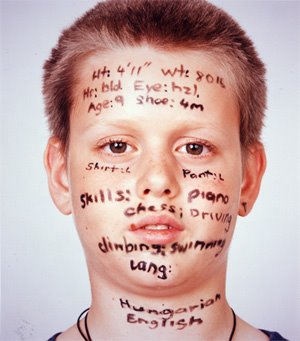
Over dinner tonight, the main topic of conversation was Essentialism. Essentialiam, simply put, is the idea that every type of being has an essential feature which distinguishes it from all other types of being. A classic example of this is the periodic table of the elements; each element has an unique atomic structure, which is the essential feature of the element. So, all of the members of the group 'gold' have the same atomic structure, a structure which is shared by no other member of any other group. Essential features mean that each group also has certain properties. So, gold has a particular malleability, reaction to acids, and so on; properties which arise naturally out of its atomic structure.

But, we didn't talk about the periodic table over our chicken salad. The question we tried to answer was rather the following: If every different thing can be separated out by its essential feature, and recognized by that and by its special properties, well then, how could we actually work with that in practice, and how would that work for classifying ourselves, or groupings of which we are members?

So, for something like biology, for example what sets man apart from other animals, or cats apart from dogs, or frogs from toads, perhaps Essentialism is more defensible...aren't we sort of classified by our DNA? (Biologists, please chime in here, as I have no idea what I'm talking about). And the properties would presumably arise from that. But what about for other things? For example, beauty. Is there an essential feature that describes all beautiful things and no non-beautiful things? If this were possible, of course, then that would presuppose some universal standard of beauty, which would be a bit of a digression here. Or for languages: the Scandinavian languages are often (though not as often as I would have thought before moving to Denmark) mutually intelligible; yet speakers of these languages would see them as different. What is the essential feature for each of these languages which would set it apart as a language? (Answer: political identity, in my opinion).

And then, for socially constructed groupings. Danes, for example. Although Thor did point out that Danes do have one essential feature: they have cartoons. But that's a relatively new feature; what about before that? It can't be just geography, as there are Danes scattered around the globe. It can't be just passport, as there are people who have been born and raised in Denmark, but who are technically citizens of other countries. It was very difficult to come up with an essential, defining feature for this type of grouping.

Of course, that may be just because neither Thor nor I consider ourselves to be Essentialists. However, that doesn't make it less interesting as a thought exercise. So, now that we've played with it for awhile, I'd like to pass it on to all of you. Please mull it over, and try to define, if you can, what essential feature binds together and sets apart groupings that you belong to (or anything other you can imagine). I find I can do it but only on a very basic definitional level...Americans are set apart by nationality, expats are set apart by not living in their country of birth, women are set apart by having a particular gender, and so on. So, I'm looking forward to reading about how you would approach it, and what you come up with.

*inspiration and the element examples courtesy of The Poverty of the Linnaean Hierarchy : A Philosophical Study of Biological Taxonomy by Marc Ereshefsky.

**photo: the dangers of essentialism, from http://www.myrelchernick.com/maternalmetaphors/images/Andrea'sArticle/Bogyi-and-Mike.jpg

fredag, september 23, 2005

Quick, time travel me to the end of this book!

(Caution, this type of thing invariably contains spoilers)

It is, of course, completely my fault. When reading something, I cannot just read. I try to do this, but at some point in the process, I invariably must also go and look at the reviews of others. This feels a bit slimy always, not to mention underhanded. Can't I form my own opinion? The proof that I can is when my opinion is so different from the prevailing criticism. For example, on occasions like this.

The book in question is The Time Traveler's Wife. The first several reviews I read, and those that I had seen before reading were clear. The book was stunning in every way. It had romance, sci-fi, compelling plot twists, romance, an unusual reworking of the time travel motif, and did I mention that it had a great romance? These made me desperate enough to contemplate posts like 'How can they all like this so much?' Then I discovered that you can rank Amazon customer comments by worst ranked, and found dozens of people who thought even less of the book than I did, much, much less. The book was flat, the romance uninspiring, the language either faux intellectual or unnecessarily graphic. All that inspired another title, the antithetical 'Then again, it's not that bad'.

Of course, all of this is a lie. While I am an obsessive review reader, I normally wait until the end of a book or film before reading them, to avoid spoilers. The first post I really wanted to write about this book would have been titled 'It is not romantic to spend your entire life waiting for a man'. For those who don't know the story, the main male character, Henry, has a time traveling problem - he does it, involuntarily, in ways that bring danger for him and suspense for the reader. Some of his time travels involve visiting his wife in her childhood, so that Clare (that's the wife) ends up having known the adult Henry from when she was six. The book has a great premise. It's well written, and fairly well plotted out, especially in the beginning. I was hooked from the first page. But then it started to gnaw at me: this woman has been with this man for her whole life. She spends her childhood and adolescence waiting for his visits, which has to have an emotional effect on her. She then meets him in the present, and proceeds to wait for him throughout her adulthood, which is defined by his disappearing and reappearing. It's clear throughout that he will die first and that she will then wait for him for the rest of her life, and that is what happens, with her living her life just waiting for a promised final time when Henry will appear in her life. She is a woman who can do nothing but wait for a man. How is this romantic?

That was my prevailing thought for the first 200 or so pages. Then the blog review in my head shifted, became more like 'when on Earth will this end?' Or even 'Will this book ever end?' I felt I had to make it through all 500-plus pages (explaining the 'it's not that bad' title...I don't generally feel compelled to finish bad books.) I almost made it. By about 60 pages before the end, I had skimmed ahead (my other very bad reading habit) enough to know exactly what was going to happen, in great detail. I then just had to read until it happened in my normal time track of reading the book, as opposed to in my time travels into the future of the plot. I couldn't do it. I couldn't read another useless paragraph not advancing the plot. But I had to read anyway. But I didn't want to. I felt that the pages I was reading were stealing time away from other more worthy books, or schoolwork, or something. This compulsion/revulsion lasted until the moment when I felt compelled to read a final paragraph or two before putting the book on the self-return machine at the library and watching it slide away on the machine sorter, to find its convoluted way to the next person on the waiting list (which the library computer system says is 7-9 months long, so the hype must be strong here, too.)

So, in short I can recommend it, but only under the following conditions:

1) You must be a complete romantic. Or, you must ignore the implications of what Henry and Clare's relationship means for Clare's independence, or lack thereof.

2) Buy the Reader's Digest Condensed version.

fredag, juli 01, 2005

Yes Men. Or should that be, yes! Men....*

I recently went to see the docu-movie 'The Yes Men', a film about two radical dudes and their radical friends who impersonate WTO spokesmodels to righteous (or should that be 'lefteous'?) and often hilarious effect. I enjoyed the film, found myself laughing at the appropriate places (unlike quite a few of my fellow audience), and overall quite recommend it. In fact, if you haven't already, then go see it. Now. And yet..and yet...there is a part of my political self that is sent vaguely akilter by the Yes Men experience. Here is why.

But before I do anything else, let me justify my political position. I am aware of the evils (real or imagined) of the WTO. I am aware of global poverty, and the plight of workers in the world (both developing and developed). I see myself, in short, as a liberal right-thinking individual. And that I feel I need to state this before I can be critical of this film is quite probably the main critique I have against it.

What the Yes Men say and do during the film, to several audiences worldwide, is clever and subversive. I am sold on their message. However, I was sold before I went in to the film. I cannot imagine that I would have 'gotten' what the film was about had I not bought into it beforehand. For this reason, I am perturbed. I want a film that right-wing globalization embracers can go to and be enlightened. But that seems frankly impossible, any more than I could read an Ann Coulter book and come away 'enlightened' (admittedly I haven't tried it, but her blog is quite enough to scare me off, thank you.)

So is asking for a funny righteously radical film which could both amuse and inform unrighteous reactionaries asking for too, too much?


*This works better for Danish speakers...'men' in Danish is 'but' in English.